If you've been dealing with a stubborn tendon or musculoskeletal injury that doesn't seem to improve with rest, stretching, or other treatments, you may have come across shockwave therapy as a potential option.
Despite the name, shockwave therapy doesn't involve electrical shocks. Extracorporeal shockwave therapy (ESWT) uses acoustic pressure waves that are delivered into a targeted area of the body. It has become increasingly used in musculoskeletal medicine, particularly for certain chronic tendon and soft-tissue conditions.
At Juke Chiropractic & Sports Rehab in Boise, we use the PiezoWave2 shockwave system as one of the treatment options available for appropriate musculoskeletal conditions.
What Is Shockwave Therapy?
Shockwave therapy is a non-invasive treatment that delivers acoustic energy into a targeted area of tissue.
There are different types of shockwave technology, and not every machine marketed as "shockwave" works the same way. The PiezoWave2 used in our office utilizes piezoelectric technology and can deliver focused shockwaves to specific treatment depths and areas.
Rather than simply trying to temporarily decrease symptoms, shockwave therapy is often used as part of a broader treatment strategy for tissues that have become persistently painful or haven't responded as expected to more traditional conservative care.
How Does Shockwave Therapy Work?
When shockwaves are delivered into tissue, they create a mechanical stimulus within the treatment area.
The biological response to that stimulus is complex and continues to be studied. Research suggests shockwave therapy may influence pain signaling and tissue-level processes associated with healing and remodeling. The exact response depends on factors such as the tissue being treated, type of shockwave, treatment intensity, and condition.
This is also why we don't view shockwave therapy as a treatment that should simply be applied anywhere something hurts. Identifying what tissue is actually involved and why it continues to be irritated is an important part of determining whether shockwave is appropriate.
What Conditions Can Shockwave Therapy Treat?
Shockwave therapy has been studied most extensively for several chronic tendon and musculoskeletal conditions.
Some of the conditions we may consider treating include:
- Plantar fasciitis / plantar fasciopathy
- Achilles tendinopathy
- Patellar tendinopathy
- Tennis elbow
- Golfer's elbow
- Rotator cuff tendinopathy
- Calcific shoulder tendinopathy
- Greater trochanteric pain syndrome
- Other persistent tendon and soft-tissue complaints when clinically appropriate
These overlap with the musculoskeletal indications identified for the PiezoWave2 system. Research has also found potential pain improvements with ESWT across conditions including plantar fasciitis, Achilles tendinopathy, lateral epicondylitis, and rotator cuff tendinopathy, although results and optimal protocols vary between conditions and studies.
Shockwave isn't automatically the right treatment just because someone has one of these diagnoses. Your history, examination, severity of the injury, activity demands, and other health factors all matter.
What Does Shockwave Therapy Feel Like?
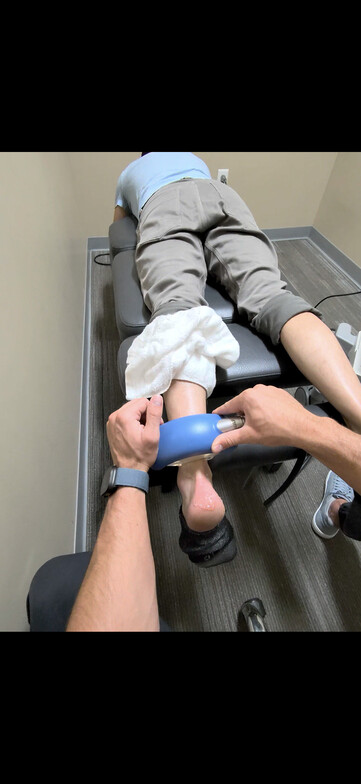
During treatment, a coupling gel is placed over the treatment area and the shockwave applicator is positioned against the skin.
Most patients describe the sensation as a repetitive tapping or pulsing feeling. Certain areas can be sensitive—especially directly over an irritated tendon—but treatment intensity can be adjusted based on the area being treated and patient tolerance.
It's also possible to experience temporary soreness, redness, swelling, or bruising around the treatment area afterward. These effects are generally mild and short-lived.
One advantage of shockwave therapy is that it is non-surgical and does not require an injection.
How Many Shockwave Sessions Will I Need?
There isn't one treatment schedule that's appropriate for everyone.
The number of sessions can depend on the diagnosis, how long the problem has been present, tissue involved, treatment parameters, and how you respond.
For that reason, we don't believe in promising that a particular injury will be "fixed" after a predetermined number of treatments.
We assess your progress throughout care and determine whether continuing shockwave therapy makes sense based on how you're responding.
Is Shockwave Therapy a Replacement for Exercise and Rehabilitation?
Usually, no—and this is an important distinction.
If you're dealing with a tendon problem, decreasing pain doesn't necessarily mean that the tendon has regained the strength and capacity required for running, lifting, jumping, playing sports, or performing your normal activities.
Appropriate progressive loading and activity management can therefore remain an important part of treatment. Clinical best-practice recommendations for shockwave therapy also emphasize appropriate load management alongside treatment for tendon and soft-tissue conditions.
At Juke Chiropractic & Sports Rehab, our goal isn't simply to treat the painful spot. We want to understand what may be contributing to the problem and help you return to the activities that matter to you.
Is Shockwave Therapy Safe?
Shockwave therapy is generally considered a well-tolerated, non-invasive treatment when appropriately used, but it isn't right for everyone.
Certain conditions and circumstances require avoiding shockwave therapy or additional clinical consideration. These can include pregnancy, active infection in the treatment area, certain tumors in the treatment area, significant clotting disorders, anticoagulant use, recent corticosteroid injections, and certain implanted medical devices, depending on the treatment location and type of shockwave being used.
That's one reason an appropriate evaluation matters before beginning treatment.
Does Insurance Cover Shockwave Therapy?
Insurance coverage for shockwave therapy can vary considerably between plans and indications, and some insurance plans may consider it a non-covered service.
If shockwave therapy is recommended, we'll discuss the cost with you before treatment so you can make an informed decision.
For more information about insurance and self-pay options at our office, visit our Pricing & Insurance page.
Shockwave Therapy at Juke Chiropractic & Sports Rehab in Boise
At Juke Chiropractic & Sports Rehab, we use the Richard Wolf PiezoWave2, which provides focused piezoelectric shockwave technology and allows treatment to be directed to different tissue depths depending on the applicator and treatment configuration.
More importantly, the machine is only one part of the process.
Our approach starts with determining what's injured, what may be contributing to it, and what the tissue needs to tolerate again. Shockwave therapy can then be incorporated when it makes sense alongside other treatment and movement-based strategies.
Whether you're trying to get back to running, lifting, golf, recreational sports, or simply everyday activity without persistent pain, the goal is to build a treatment plan around the problem—not simply around the equipment.
Is Shockwave Therapy Right for You?
If you've been dealing with a persistent tendon or musculoskeletal problem, an evaluation can help determine what's contributing to your symptoms and whether shockwave therapy is an appropriate option.
Dr. Jon Juker
Contact Me